Yabanji

Home | 2012 World Strike - the Day of Judgement | America | The British Royal Family | THE CHURCH | Israel | Religion | JESUS | Iconoclassics | Iconoclassics 2 | Old Exhibition Posters | Book Covers | The Erdogan Dog Court Case | My COUNTERPUNCH articles | MY BOOK/PLAY


MY BOOK/PLAY

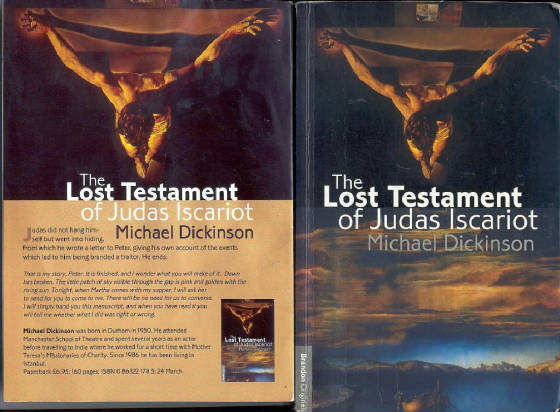
'THE LOST TESTAMENT OF JUDAS ISCARIOT' and 'THE RICH YOUNG MAN'


Description


Two thousand years ago in Roman-occupied Palestine, the scheming of a fanatical disciple results in the crucifixion of a rich young man and the foundation of a false faith which will conquer the Western World


´An ingenious fictional theory´ The Guardian
´A brave book - Pick this one up´ the Birmingham Post
´Swept me along´ Books Ireland
´Clever and cynical´ Sunday Tribune
´Controversial - A novel promising to stir up a hornet´s nest...´The Newcastle Journal
 
CLICK ON THE BOOK COVER TO READ THE NOVEL - RENAMED  'CONFESSIONS OF JUDAS' 

losttestament.jpg
CLICK PICTURE TO READ THE BOOK

Now out of print, 'THE LOST TESTAMENT OF JUDAS ISCARIOT' was first published by Brandon Books, Ireland, in 1994.  Copyright is mine again and I'm looking for a new publisher.
 

This review of 'THE LOST TESTAMENT OF JUDAS ISCARIOT' appeared in the TURKISH DAILY NEWS in 1994.
 
 
"Poor old Jesus. His image took a few literary knocks in the 1900s. There was Schweitzer's Quest for the Historical Jesus which raised early hackles; The Last Temptation of Christ by Kazantzakiz, plus the Scorsese film version; not to mention Terence McNally's Corpus Christi, or the court case brought against Britain's Gay News in the seventies for publishing James Kirkup's `blasphemous' poem.

Now, just as it seemed Christian Fundamentalist's hackles could get no higher, along comes THE LOST TESTAMENT OF JUDAS ISCARIOT by Michael Dickinson, which lands several unguarded blows below the Bible belt.

And this one doesn't pull any punches. In 120 pages, Matthew, Mark, Luke and John are out for the count, no contest against the stunning "kiss-and-tell" revelations that the miracles were faked publicity stunts; the Virgin Birth a terrified girl's invention; and even the Crucifixion and Resurrection cunning feats of deception orchestrated by this gentle Judas.

Instead of hanging himself after the events Christians commemorate every Easter, Judas hangs out in the tomb vacated by the "resurrected" Lazarus, from where he narrates his version in a letter addressed to the puzzled, half-aware Peter - a confession which rolls away stone after stone, revealing quite a different story from the one we learned at Sunday School.

The boot here is on the other foot, and perhaps in this age of anti-heroes it was about time that probably the greatest anti-hero of them all - the arch-traitor Judas Iscariot - condemned by Dante to the very lowest pit in Hell - should finally get the chance to speak in his own defense.

What emerges is a story simply and clearly told, entirely convincing and logical in its exposition, and one cannot help but pity the totally devoted and well-meaning disciple, swept helplessly along in the train of events he unleashes, bound to end in his own ruin at the expense of his Master's fame.

A short preface claims the book to be the translation of a secret, centuries-old document smuggled out of the Vatican, but I reckon that should be taken with a large pinch of salt and a firm tongue in cheek.

Nevertheless, THE LOST TESTAMENT OF JUDAS ISCARIOT is a brave, controversial and original novel which would definitely have been on the Vatican's List of Banned Books a few years ago, and the bonfire before that. Thank God (for want of a better word), we are now allowed to read what we like."

Alexander Burke 1994 

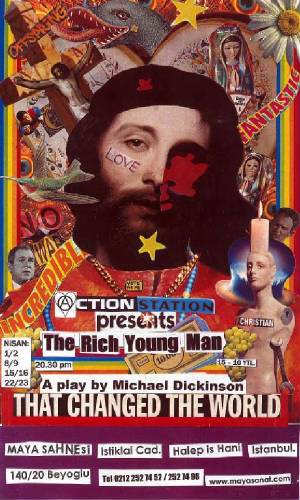
THE STORY DRAMATISED - 'THE RICH YOUNG MAN'

"America's best political newsletter" COUNTERPUNCH published the entire play on their political newsletter in 2006.  CLICK ON THE POSTER TO READ THE SCRIPT.  

playposter.jpg

I know the play works very effectively on stage having directed a production with an amateur group of mixed nationalities  in 2006 at a theatre in Istanbul, where I live. Audience reaction was positive.


 ACTION STATION

presents


THE RICH YOUNG MAN 


Written and directed by Michael Dickinson


CHARACTERS/ACTORS - (in order of appearance)


Virgin Mary                     Melis Keymen


Mary Magdalene              Alethea Simatos


Martha                            Diana Knight


'Blind' Bartimaeus           David O'Connor 


Judas                              Tommaso Adorni


Jesus                              Argus Adakarasi 


Lazarus                          Sukru Kanter


John                               Fahri Oztezcan


James                            Damon Roberts


Peter                              Matthew Turner


Darius                            Alperen Ibrahimoglu


SYNOPSIS


"Ingenious!"  "Brave!"  "Cynical."  "Controversial!"  "Silly." "Blasphemy!"  - Just some of the comments British and Irish critics used to describe Michael Dickinson's first novel 'The Lost Testament of Judas Iscariot  on its publication in 1994.  Now it's a play.


This stage adaptation by the author deconstructs the Easter Story - the betrayal, crucifixion and resurrection of the Prophet Jesus Christ.  Closely following events described in the New Testament Gospels, but with many a surprise twist, the play convincingly challenges the foundation of the Christian Church.


In order to boost the popularity of his chosen Messiah, and hurry up the coming Kingdom of God, devoted disciple Judas fakes a couple of ‘miracles’, but when Jesus asks Judas to organize his own arrest,  double-dealings get out of hand.  The result is tragedy - and the most amazing hoax in the history of the world.


Plausible, funny and sad, the play may offend the person to whom it is dedicated - His ‘Holiness’ Pope Benedict of Rome

Here is a review of the play which appeared in the Turkish Daily News following the first performance in Istanbul -


"Few figures have been subjected to as many wildly differing interpretations as has Jesus Christ: Jesus as peace loving hippie, Jesus as financially savvy capitalist, Jesus as original feminist, Jesus as husband and father -- modern-day pop culture iconography exhaustively represents the famed carpenter from Galilee.

Michael Dickinson, a veteran provocateur known for his controversial collages of eminent religious and political figures, presents Istanbul audiences with another version of the anointed one: Jesus as heartfelt charlatan, as duped about his own identity and origin as his followers are about his divine capabilities.

Dickinson, now in his mid-50s, had a Catholic upbringing but became disillusioned with Christianity in his late teens. Upon re-reading the Bible at a later age, however, he saw that “Jesus was a good guy.” “He doesn't need the miracles. I decided to remove them to see if the plot could stand miracle-free,” he said. What did he come up with? An entirely different Judas and a new role for Darius, the hero of the play. “This is a detective story of what might have occurred.”

"The Rich Young Man," a stage production of Dickinson's novel "The Lost Testament of Judas Iscariot," published in 1994, features the familiar New Testament characters: the long-suffering Mother Mary (with a previously unknown penchant for Roman soldiers), industrious Martha, bickering disciples and devoted Mary Magdalene, though much sassier and sensuous than you may remember her from Sunday school.

Dickinson, however, recasts the three pivotal characters, Jesus, Darius and Judas, in a completely unique light in this play that, in the modest words of the promotional flyer, “changed the world.”

While seeking to share his message of peace, love and freedom with mankind, Jesus has won a small following, but struggles to differentiate himself from the many other would-be messiahs that proclaim themselves to the masses every day. “Jesus wanted to establish the kingdom of heaven on earth -- not a pie in the sky idea. He tried to make earth a better place,” says Dickinson.

In this version of events, Judas, presumably out of his love for Jesus, seeks to elevate his master in the eyes of the local population through elaborately staged “miracles.” We learn that Judas gave Lazarus a potion to make him appear dead as he waited in his tomb for Christ to “resurrect” him; the infamous apostle blackmailed “blind” Bartimaeus to proclaim Christ healed him of an ocular affliction he never had in the first place. Judas schemes and organizes; Jesus reluctantly complies for the sake of attracting more listeners, yet chafes at the primarily miracle-seeking crowd his reputation now draws. “Miracles attract the wrong sort,” he bemoans.

As Jesus and company prepare to depart from Bethany for a triumphant Passover feast in Jerusalem (in spite of practical advice otherwise from the headstrong Mary Magdalene), a persistent stranger demands an audience with Jesus. The newcomer is Darius, the rich young man for whom Jesus had predicted it would be harder to enter the kingdom of heaven than for a camel to pass through the eye of a needle. Darius exclaims that he has renounced his wealth and incurred the wrath of his family to follow Jesus, who welcomes him into the group as they set off.

The Jerusalem visit turns into a disappointment for the disciples as they make do with chicken rather than lamb and face mockery from city residents, for whom messiahs seem to be a dime a dozen.

“As we were coming through the gates shouting our hosannas, this trader came up and asked what was going on. I told him the Messiah had come. ‘What, another one?' he exclaims. ‘That's the fifth we've seen today! May the best man win!'” James recounts to the group. John echoes disillusionment, “We're just another Passover distraction, and Jerusalem is full of them.”

This time it is Jesus rather than Judas who devises a grand scheme to turn up the heat on his message and boost his notoriety, both for the sake of his message and to hearten the disciples. Judas must betray Jesus to the Pharisees, thereby thrusting him into the spotlight as a candidate for the traditional Passover amnesty. Jesus, more confident than realistic, is certain the crowds will choose him, elevating him to the notoriety that he and his followers seek. Judas complies, but his troubled conscience compels him to confide first in Darius, leading to a tragic case of mistaken identity, with repercussions felt far beyond the small group in the olive grove.

Keeping up with the twists, turns and revelations requires unflagging attention from the audience. While the novice actors have to work hard in this dialogue-rich production, they succeed by and large in presenting the human side of the characters they portray -- particularly the pure-hearted Peter, exasperated John and scheming Judas.

The most convincing aspect of the production may be the physical appearance of Jesus and Darius. Jesus as played by Argus Adakarasi perfectly embodies Western preconceptions. The sparkling light eyes and firmly set jaw bespeak vision. This Jesus has just enough of a tan to convince us he spends time praying in the desert, yet his trimmed beard and flowing straw colored hair point to a leader moved by the innocence of little children and lost lambs. In his long white robe the overall image borders on campy.

While Jesus is prone to getting swept away with events, Darius, played by Eren Alperen, emanates steady peace and resolve. His arching brow frames pained eyes as the henchmen lead him away. Dark thick hair and beard set off his drawn features. If Darius tilted his head just so, it wouldn't be surprising to see his image flatten into an Orthodox icon of muted gold, or perhaps morph full-bodied onto a Catholic cross with downcast gaze and bleeding abdomen. How fitting for the ultimate sacrifice Dickinson's rich young man makes for his lord. ------ "

http://www.turkishdailynews.com.tr/article.php?enewsid=39631


Enter supporting content here